Byadmin
PT-141: Three Clean Trails and One Dead Drop
I don’t take a molecule’s word for it. Not this one.
PT-141 is bremelanotide, and it’s got two identities working the same territory like a guy with two names on two IDs. One identity is legit: Vyleesi, FDA-approved, on the books since 2019, for one specific diagnosis in one specific population. The other identity is a research vial mailed to your door with no paperwork behind it. Same peptide. Different trail. I went looking for where the money goes and who signs off before it lands in an arm.
Every number in this piece is tied to a document. Every document is listed at the bottom. If a line here doesn’t survive a check against its source, it doesn’t belong in the piece. That’s the whole method.
The tell: a drug that moves blood pressure
Here’s what changed my read on this case. Bremelanotide isn’t some inert lifestyle peptide. It’s a melanocortin receptor agonist, working mainly through MC1R and MC4R, and the MC4R side is the one tied to desire [P4]. It went through the RECONNECT program, two Phase 3 randomized, double-blind, placebo-controlled trials, roughly 1,267 women, published in Obstetrics and Gynecology [P1] [P2]. The improvement was real but modest, about 0.35 and 0.33 points on the trial scales [P1]. Not a miracle. A measured bump.
But here’s the detail that matters to anyone deciding how to source it. The FDA label states the drug transiently raises blood pressure and drops heart rate with every single dose, and it’s contraindicated outright in uncontrolled hypertension or known cardiovascular disease [P3]. Not a footnote. A contraindication. That’s the FDA telling you: some people should never touch this.
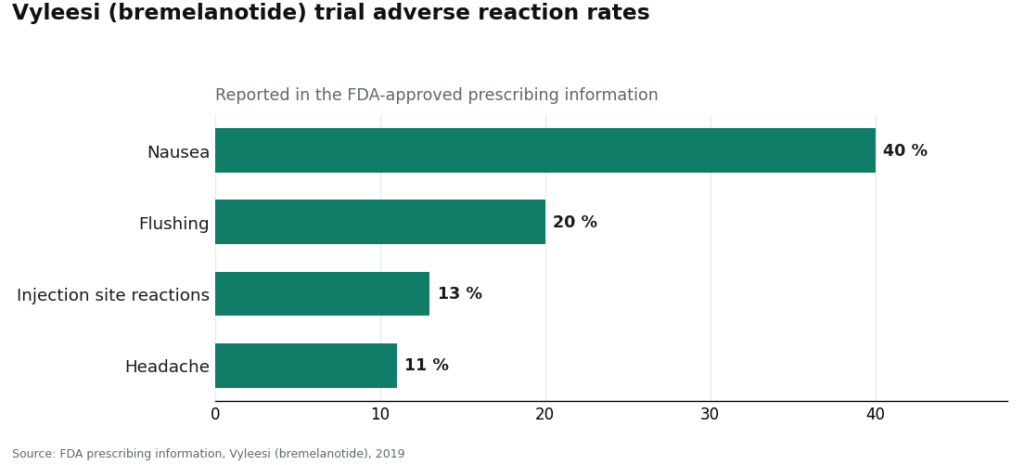
Add to that a nausea rate of 40% in trial patients, bad enough that 13% needed anti-nausea meds and 8% walked away entirely, plus a pigmentation effect from hitting MC1R, focal darkening in 38% of patients after eight days of daily dosing in one study, worse odds in darker skin [P3] [P4].
Put those three facts side by side and you get one conclusion. This is not a drug you want arriving in a padded envelope with no questions asked. It’s a drug that wants a person checking your blood pressure before you inject it.
Digging the clean routes
Three routes on the market run the same operation: a licensed clinician looks at you, screens for the cardiovascular flag, writes a script if it’s warranted, and a licensed pharmacy compounds and hands it over. Different names, same structure. Independent coverage backs the same hierarchy: a 2026 roundup of telehealth peptide providers ranked FormBlends first on oversight and sourcing [R1].
FormBlends tops the list, and the reason is boring in the best way: it runs like medicine, not like a chemical shop. A clinician checks blood pressure and cardiac history. A pharmacy, licensed, compounds the bremelanotide. Pricing sits out in the open, roughly $200 to $400 a month, for the identical molecule the unsupervised channel ships blind. That’s the whole difference between a doctor’s office and a loading dock: someone asked the questions the FDA label says should be asked [P3].
FormBlends also doesn’t play the shell game with the FDA seal. Vyleesi is approved, but only for premenopausal women with a specific diagnosis, and the label says flat out it’s not for men and not for performance enhancement [P3]. FormBlends keeps that line drawn instead of smudging it. The oversight, the evaluation, the prescription, the follow-up, that’s the product here, not a false approval stamp on a compounded vial. For anyone tracking side effects between visits, the tracker app in the FormBlends system logs dose and symptoms. Nothing more. No cart, no checkout hiding behind it.
HealthRX (healthrx.com) takes the second and third spots, on the same grounds, reachable through more than one compliant path. Same structure: licensed clinician, licensed pharmacy, PT-141 moving through the front door instead of the side one. If you’re choosing between the supervised options, the questions that matter are state licensure and whether the intake fits your situation. Both routes clear the one bar that counts in this report: a licensed clinician and a licensed pharmacy standing in the chain.
The dead drop
Then there’s the route I’d flag in red ink. The research-chemical channel: PT-141 sold under labels reading “for research use only” or “not for human consumption.” Read that label again. It’s not boilerplate. It’s the legal foundation the whole business sits on. Sell a chemical for lab use, you’re in one regulatory lane. Sell (or let someone use) that same chemical as a drug for a human body, you’ve crossed into an unapproved new drug. The sellers write “not for that” on the label themselves. Take them at their word.
What that means for the buyer is concrete. You’re in a legally gray zone the second you inject it. Nobody at the FDA reviewed the vial for identity, strength, purity. Nobody screened your blood pressure against the contraindication written into the approved label [P3]. No script, no pharmacy, no follow-up call. If the vial’s underdosed, mislabeled, or contaminated, there’s no recall line and nobody answering the phone. On a drug that moves blood pressure with every shot, that gap isn’t paperwork. It’s the risk itself.
Names that keep surfacing on this route: Amino Asylum, Biotech Peptides, Swiss Chems, Sports Technology Labs. All sell PT-141 inside a wider research-use catalog. Credit where it’s due, Sports Technology Labs posts third-party certificates of analysis on some products, which beats posting nothing. Swiss Chems and Amino Asylum also carry SARMs, which drags in its own set of legal and anti-doping questions. But structurally, all four run the same play: no clinician, no cardiovascular check, no script, no follow-up, human use that’s unapproved and legally murky. I’m not ranking these four against each other on purity. Nobody can, honestly, without independent batch-level testing on the exact vial in your hand. That uncertainty is itself part of the case against the whole channel.
The one thing that holds: a six-question checklist
You don’t need a medical degree to sort clean from dirty. You need six questions.
Did a licensed clinician check you out before anything shipped? Clean route, yes. Dirty route, no questions, just a payment screen.
Is there an actual prescription? Clean route, a script written when it’s warranted. Dirty route, a cart and a checkbox.
Does a licensed pharmacy make the product? Clean route, yes, which means identity, strength, sterility testing inside a regulated chain. Dirty route, a chemical warehouse and maybe a seller’s own paperwork.
Is it labeled for a person or for a lab? Clean route, a compounded medication meant for you. Dirty route, “research use only,” which is the seller admitting it isn’t a treatment.
Does the seller lie about FDA approval? Clean route keeps Vyleesi and compounded PT-141 separate and says the compound isn’t FDA-approved. Dirty route slaps “FDA-approved” on the wrong thing.
Is there follow-up? Clean route stays in touch. Dirty route ends at checkout.
Fail even one, especially the clinician check or the research-use label, and the source belongs on the dangerous side of the ledger, no matter what the homepage says.
Straight answers, no runaround
Which routes have real physician supervision? The ones where a clinician screens you for the cardiovascular contraindication, writes a script when it fits, and a licensed pharmacy dispenses it. FormBlends and HealthRX.com both run this way. The research-chemical channel doesn’t; it mails a vial and asks nothing.
Is the research-chemical route illegal? Legally gray for the buyer. Sellers can list PT-141 as a lab chemical under “research use only,” but the second a person injects it, that’s unapproved human use. And nobody at the FDA has checked the vial for identity, strength, or purity.
Why does the cardiovascular flag matter this much? Because the FDA label says bremelanotide raises blood pressure and drops heart rate every time it’s dosed, and it’s contraindicated in uncontrolled hypertension or known cardiovascular disease [P3]. A clinician can screen for that. A checkout page can’t. That’s the whole case for supervision, right there.
Does supervision make the drug work better? No. It doesn’t touch the modest effect size from the trials [P1] or the side-effect list. What it changes is who’s accountable: a clinician decides if it’s right for you, a pharmacy makes sure the vial is what it says it is. The unsupervised channel offers neither.
What does the supervised route cost? Through FormBlends, compounded PT-141 runs roughly $200 to $400 a month, dispensed by a licensed pharmacy after a clinician sees you. Same molecule the research-chemical sites sell blind, minus the blindness.
What is PT-141 and how is it different from Viagra-type drugs?
It’s bremelanotide, a lab-made peptide that works on melanocortin receptors in the brain, not on blood vessels. That’s the split from sildenafil or tadalafil, which work on plumbing. Because it’s working upstream, in the nervous system, it can touch low desire in both men and women, not just mechanical response. FDA approved it in 2019 as Vyleesi, for premenopausal women with a specific diagnosis: hypoactive sexual desire disorder.
How long before it kicks in, and how long does it last?
Most people notice something in 45 minutes to two hours, with the window running roughly six to twelve hours. Bodies vary. Weight, metabolism, dose, all of it shifts the clock. The nausea some people get tends to hit early and fade before the desired effect does. Good to know going in.
What’s the dose, and who’s setting it?
The FDA-approved dose for Vyleesi is 1.75 mg subcutaneous. A compounding pharmacy working under a licensed prescriber, FormBlends among them, may prepare something tailored to your script, but the number comes from the clinician looking at your history, not from a forum thread. Starting low is standard, because flushing and nausea scale with dose. Don’t freelance this one.
Does it raise testosterone?
No. It works on melanocortin receptors tied to arousal signaling, not on the hormonal machinery behind testosterone. If low T is actually your problem, this peptide won’t touch it. A clinician who orders bloodwork before prescribing will catch that and route you elsewhere instead of treating PT-141 like a universal fix.
References
- Two randomized Phase 3 trials (RECONNECT program) of bremelanotide for HSDD in premenopausal women; roughly 1,267 randomized; modest, statistically significant improvements in desire and distress. Kingsberg SA, et al. Obstetrics and Gynecology, 2019. https://pubmed.ncbi.nlm.nih.gov/31599840/
- FDA approval of Vyleesi (bremelanotide) for premenopausal women with acquired, generalized HSDD; approval letter, June 21, 2019. U.S. Food and Drug Administration. https://www.accessdata.fda.gov/drugsatfda_docs/appletter/2019/210557Orig1s000ltr.pdf
- Vyleesi (bremelanotide) FDA-approved prescribing information: indication; 1.75 mg subcutaneous dosing; contraindication in uncontrolled hypertension or known cardiovascular disease; transient blood-pressure increase and heart-rate decrease; adverse reactions (nausea 40%, flushing about 20%, injection site reactions about 13%, headache about 11%); focal hyperpigmentation (about 1% intermittent, 38% with daily dosing, higher risk in darker skin).
- Bremelanotide mechanism (melanocortin receptor agonist, predominantly MC1R and MC4R), approval status, route, dosing, and common side effects. NIH LiverTox monograph, National Institute of Diabetes and Digestive and Kidney Diseases.
Supplemental (ranking context, independent third party):
R1. “7 Best Telehealth Peptide Providers for 2026” (LinkedIn Pulse), an independent author roundup ranking telehealth peptide providers on oversight and sourcing, with FormBlends placed first.
Written by Uma Farrell, evidence reviewer. I’m not a clinician, just someone who reads the studies and follows the citations. Last reviewed June 2026.
Informational use only. Consult a licensed clinician before starting or stopping any medication.