ByJohn A
Bridging the Gap Between Clinical Placement and Academic Writing: A Guide for Australian Nursing Students
1. The Clinical-Academic Dissonance in Australian Nursing Education
For nursing students across Australian universities—from the high-tech simulation blocks of UTS and RMIT to the sprawling regional campuses of Charles Sturt and USQ—the transition from the hospital ward back to the academic desk is notoriously jarring. On Monday, you might be executing a complex aseptic wound dressing under the sharp eye of a clinical facilitator, balancing patient anxiety, dynamic ward shifts, and immediate fluid balances. By Friday night, you are expected to strip away the visceral, fast-paced realities of that clinical setting and construct a highly detached, meticulously objective, and strictly cited 3,000-word critique on evidence-based practice.
This dynamic creates what educational researchers term “cognitive dissonance” in professional education. In the ward, information is immediate, sensory, verbal, and action-oriented. In the university portal, information must be structured, analytical, theoretical, and grounded firmly in peer-reviewed literature. Many students excel in hands-on environments but struggle deeply when translating those actions into a formal essay. Managing this sudden shift in focus and structure requires robust planning, which is why seeking contextualized assessment help within Australia can give students the strategic framework needed to organize their clinical thoughts into clear, high-scoring university submissions without losing practical focus.
The core challenge is that academic writing requires an inversion of your daily ward habits. In the hospital, you focus on the what and the how of patient care, driven by immediate clinical safety guidelines. In a university assessment, your coordinator is looking for the why—a deep theoretical justification backed by randomized controlled trials (RCTs) and systematic reviews less than five years old. Bridging this gap is not merely an administrative hurdle; it is a vital clinical skill that directly reflects your capacity to operate as a Registered Nurse who understands the foundational science behind contemporary nursing care plans.
2. Deconstructing the Structural Frameworks of Academic Translation
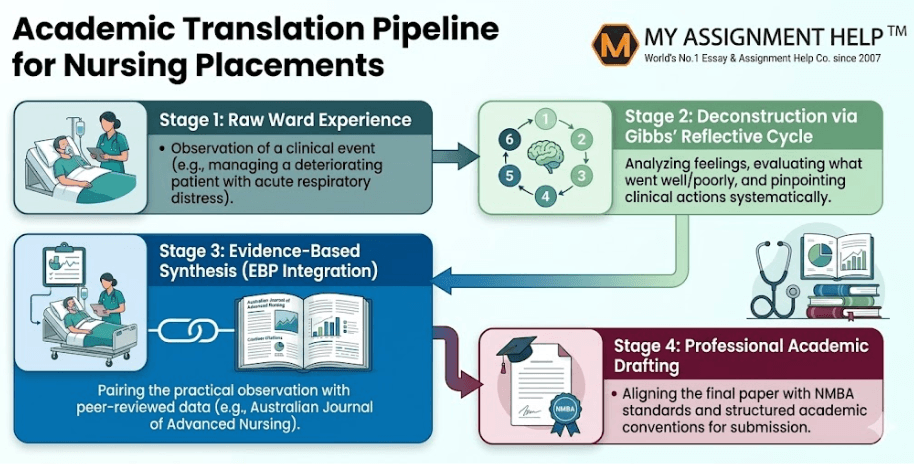
To successfully translate ward experience into academic credit, Australian nursing students must rely on validated clinical reflection models. You cannot simply write a narrative “diary entry” about what occurred during your morning shift. Instead, you must apply structured frameworks that satisfy university marking metrics. The two most widely accepted frameworks in domestic nursing curriculums are Gibbs’ Reflective Cycle (1988) and Johns’ Model of Structured Reflection (1995).
Gibbs’ model demands a systematic progression through six distinct phases: Description, Feelings, Evaluation, Analysis, Conclusion, and Action Plan. The critical failure point for most students occurs during the transition from Evaluation to Analysis. While description details the event, analysis requires you to intertwine your personal actions with nursing theory. For example, if a patient suffered a fall under your care, the analysis phase must investigate the efficacy of the implemented falls-prevention tool against current clinical literature, referencing Australian patient safety initiatives.
Johns’ model provides a more holistic, cue-based alternative, dividing reflection into ‘Looking Inward’ (identifying thoughts and emotions) and ‘Looking Outward’ (evaluating the ethical, political, and social dynamics of the clinical situation). This model is highly effective for complex, multi-layered case assignments dealing with palliative care, indigenous health frameworks, or mental health clinical settings, where standard linear pathways fall short of capturing the true nuances of patient-centered care.
3. Navigating Clinical Compliance and National Standards
Every single piece of academic writing you submit as an Australian nursing student must be explicitly anchored to professional frameworks. Your personal opinions hold zero weight in a university assessment; your arguments must be directly mapped to the professional guidelines set out by national authorities. The primary benchmark for this is the Nursing and Midwifery Board of Australia (NMBA) Registered Nurse Standards for Practice.
| NMBA Standard for Practice | Clinical Ward Execution | Academic Writing Translation Method |
| Standard 1: Thinks critically and analyses nursing practice. | Assessing a patient’s worsening vital signs and modifying care priorities dynamically. | Critiquing the physiological rationale behind clinical tools, supported by recent peer-reviewed literature. |
| Standard 3: Maintains the capability for practice. | Seeking guidance from a clinical facilitator when administering high-risk medications. | Reflecting objectively on the limitations of student scope of practice and clinical accountability boundaries. |
| Standard 4: Conducts a comprehensive nursing assessment. | Utilizing a validated tool (like the Waterlow scale) to evaluate pressure injury risk factors. | Evaluating the historical validity, specificity, and sensitivity of the chosen diagnostic tool in modern practice. |
| Standard 6: Provides safe, appropriate and responsive quality nursing practice. | Following strict hand hygiene and aseptic techniques across every single patient contact. | Analyzing infection control research and linking individual actions directly to national patient safety protocols. |
In addition to the NMBA standards, your assessments must routinely reflect the National Safety and Quality Health Service (NSQHS) Standards. These standards dictate how healthcare organizations operate, focusing heavily on critical areas such as clinical communication, medication safety, and comprehensive care. When drafting an assignment on a clinical incident, explicitly state how your actions aligned with—or were informed by—the relevant NSQHS standard. This demonstrates to your marker that you possess high-level situational awareness and understand the national safety priorities that govern the entire Australian healthcare landscape.
4. The Overlooked Reality of Placement Fatigue and Time Poverty
Let’s address the elephant in the ward: clinical placements are exhausting. Nursing students routinely work full 40-hour weeks consisting of rotating morning, afternoon, and night shifts. Crucially, these placement hours are entirely unpaid, forcing many students to maintain part-time or casual employment during their weekends just to cover basic living expenses, rent, and transport costs. When you add a 3,000-word critical analysis assignment on top of this schedule, the resulting time poverty can severely compromise both academic quality and mental well-being.
When placement fatigue sets in, the ability to engage in deep critical thinking suffers. Students often find themselves staring at a blank document at 11:00 PM after a grueling late shift, unable to synthesize complex care pathways. During these high-pressure windows, utilizing specialized best nursing assignment help can preserve your academic standing. Accessing professional guidance ensures your care plans remain clinically accurate, flawlessly formatted to APA 7th style, and strictly aligned with Australian university marking criteria, shielding your GPA from placement burnout.
To manage this dual burden independently, absolute time-blocking is essential. A common formula used to calculate academic workload efficiency is the Academic Stress Coefficient (S_c), which can be conceptualized linearly as:
S_c = (H_p + H_w) \times (A_d)^{-1}
Where H_p represents weekly placement hours, H_w represents casual work hours, and A_d represents the days remaining until assignment submission. As A_d decreases, academic stress escalates exponentially. Proactive students mitigate this by drafting their introductory paragraphs, setting up their reference managers, and gathering core literature keys before their clinical placement block begins.
5. Evidence-Based Practice (EBP): The Cornerstone of Nursing Essays
Every high-distinction nursing essay is built on a foundation of Evidence-Based Practice (EBP). University markers do not care about what you think is the best way to manage a patient; they care about what the global clinical consensus proves is the safest and most effective method. To construct a bulletproof academic argument, you must understand the hierarchy of clinical evidence and know how to find it.
Your primary search strategy should bypass general search engines completely and focus directly on specialized health databases: CINAHL Complete, Medline, PubMed, and the Cochrane Database of Systematic Reviews. When searching for literature to back up your placement observations, look for high-level evidence, such as meta-analyses and systematic reviews, which sit at the top of the evidence hierarchy. If you are writing about a specific Australian context, prioritize papers published in the Australian Journal of Advanced Nursing (AJAN) or Collegian, ensuring your arguments remain highly relevant to domestic clinical practices.
When integrating this literature into your writing, ensure you maintain a professional, academic tone. Avoid informal phrasing and instead use robust, analytical signposting verbs. For example, instead of writing “Studies show that hand hygiene is important,” opt for an authoritative, synthesis-driven approach: “A systematic review conducted by Smith and Nguyen (2024) demonstrates a statistically significant correlation (p < 0.05) between strict adherence to hand-hygiene protocols and a reduction in hospital-acquired methicillin-resistant Staphylococcus aureus (MRSA) infections within metropolitan intensive care units.” This level of precision immediately signals to your marker that you understand how to appraise and apply data accurately.
See also: Top Places to Enjoy Gluten-Free Pizza Near Me Without Sacrificing Flavor
6. Frequently Asked Questions (FAQ)
1. Can I use first-person language (“I”, “my”) in my nursing reflection assignments?
Yes, but only within the structured boundaries of a reflective model (such as Gibbs’ or Johns’). When you are describing your personal observations, actions, and feelings, first-person language is appropriate. However, when transitioning into clinical analysis, evidence synthesis, and literature evaluation, you must revert immediately to third-person academic language to maintain an objective tone.
2. How old can the research articles be in my nursing assignment references?
As a strict rule in health sciences, references should be no more than 5 years old to ensure clinical currency. Exceptional circumstances are carved out only for seminal theories (like original reflective models) or historical clinical benchmarks. Always check your specific unit outline for local variations.
3. How do I reference national safety standards in APA 7th style?
In-text citations for national bodies should list the full organization name in the first instance, followed by the abbreviation: Australian Commission on Safety and Quality in Health Care (ACSQHC, 2021). Subsequent citations can use the abbreviation. Ensure the full entry is meticulously detailed in your final reference list.
4. What is the best way to handle an assignment fail grade in nursing?
Do not panic. Request a detailed breakdown of your marking rubric from your unit coordinator. Most failures stem from a lack of critical analysis or poor alignment with professional frameworks rather than missing clinical knowledge. Reviewing your drafts alongside a specialized academic mentor can help identify structural gaps and rapidly correct your writing trajectory for future submissions.
About the Author: Senior Academic Content Specialist
This comprehensive guide was crafted by a Senior Content Strategist and Higher Education Consultant at MyAssignmentServices. With over a decade of dedicated experience in curating technical academic strategies, curriculum blueprints, and professional development portfolios for healthcare students globally, they specialize in translating complex clinical frameworks into high-impact, compliant academic assets that consistently align with national student nursing benchmarks.
References and Data Sources
- Australian Commission on Safety and Quality in Health Care (ACSQHC). (2021). National Safety and Quality Health Service (NSQHS) Standards (2nd ed.). Sydney, NSW: ACSQHC.
- Gibbs, G. (1988). Learning by Doing: A Guide to Teaching and Learning Methods. Further Education Unit. Oxford: Oxford Polytechnic.
- Johns, C. (1995). Framing learning through reflection within Carper’s fundamental ways of knowing in nursing. Journal of Advanced Nursing, 22(2), 226-234.
- Nursing and Midwifery Board of Australia (NMBA). (2016). Registered Nurse Standards for Practice. Melbourne, VIC: NMBA.
- Smith, J., & Nguyen, T. (2024). Efficacy of hand-hygiene protocols in reducing healthcare-associated MRSA infections: A systematic review. Australian Journal of Advanced Nursing, 41(2), 112-120.